

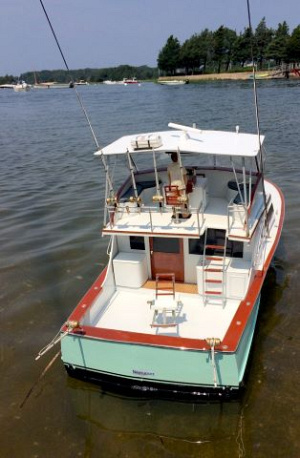
Nothing earth shattering but a few more details to make it more interesting. Radar is operational; currently operating on a 1.5v flat battery. Final arrangement will consist of a buck/boost board set at 1.5 v (input 5.5v from BEC) & programmed to a switch on the tx.
Since I hope to use the boat in steering & towing events included details will be minimized & be durable enough to stand up to hard use.
[{"id":"174489354493","name":"174489354493","caption":"","url":"https:\/\/hobby.land\/media\/174489354493\/l","thumbUrl":"https:\/\/hobby.land\/media\/174489354493\/s","isImage":false,"ext":"file"},{"id":"174489354818","name":"174489354818","caption":"","url":"https:\/\/hobby.land\/media\/174489354818\/l","thumbUrl":"https:\/\/hobby.land\/media\/174489354818\/s","isImage":false,"ext":"file"}]
Nothing earth shattering but a few more details to make it more interesting. Radar is operational; currently operating on a 1.5v flat battery. Final arrangement will consist of a buck/boost board set at 1.5 v (input 5.5v from BEC) & programmed to a switch on the tx.
Since I hope to use the boat in steering & towing events included details will be minimized & be durable enough to stand up to hard use.
Returned home so back at it with THUNDER.
Photo#1 Overall view.
#2 Shoulder bitts installed.
#3 Railings completed.
#4 Beginning to add some deck clutter.
#5 Radar now operational; mast started.
More on the radar installation in the next post.
Turned out to be an interesting experience.
[{"id":"174856634567","name":"174856634567","caption":"","url":"https:\/\/hobby.land\/media\/174856634567\/l","thumbUrl":"https:\/\/hobby.land\/media\/174856634567\/s","isImage":false,"ext":"file"},{"id":"174856635669","name":"174856635669","caption":"","url":"https:\/\/hobby.land\/media\/174856635669\/l","thumbUrl":"https:\/\/hobby.land\/media\/174856635669\/s","isImage":false,"ext":"file"},{"id":"174856652241","name":"174856652241","caption":"","url":"https:\/\/hobby.land\/media\/174856652241\/l","thumbUrl":"https:\/\/hobby.land\/media\/174856652241\/s","isImage":false,"ext":"file"},{"id":"174856669016","name":"174856669016","caption":"","url":"https:\/\/hobby.land\/media\/174856669016\/l","thumbUrl":"https:\/\/hobby.land\/media\/174856669016\/s","isImage":false,"ext":"file"},{"id":"174856704368","name":"174856704368","caption":"","url":"https:\/\/hobby.land\/media\/174856704368\/l","thumbUrl":"https:\/\/hobby.land\/media\/174856704368\/s","isImage":false,"ext":"file"}]
Photo#1 Overall view.
#2 Shoulder bitts installed.
#3 Railings completed.
#4 Beginning to add some deck clutter.
#5 Radar now operational; mast started.
More on the radar installation in the next post.
Turned out to be an interesting experience.
Excellent photos Alessandro as well as a good history lesson. Ahh, the beauty of Italia; ancient works of architecture & culture amidst modern functionality.
Today, I saw a very similar but smaller version of the white mega yacht you photographed. It looked quite out of place in Falmouth Harbor.
One could spend a lot of time in Civitavecchia studying details of the fishing boats & tugboats. Like you I’m no fan of those huge yachts.
Thanks for posting these photos & the ones of the AMERIGO VESPUCCI.
In an RC boat forum in the U.S. there was an extensive discussion about electrical connection methods between removable parts such as deckhouses and/or the roofs of deckhouses that have operating radars, navigation lights, etc.
Since I use rare earth magnets to secure removable deckhouses and roofs I particularly liked the suggestion of using those magnets as the contacts. Sounds great; one component serving both as a hold down force & an electrical contact. Yet I vaguely recalled from one of my numerous physics or metallurgy classes that magnets & heat don’t play nice together. Undaunted I proceeded anyway. Using what I thought to be minimal heat to solder the wires to the magnets caused about 85% of their magnetism to be lost. So four additional magnets had to be installed to hold the wheelhouse roof in place. Fortunately I had enough magnets & space to do so.
Photo 1 Wires from 1.5v output side of buck/boost circuit board soldered to outboard hardly magnetic magnets. Input voltage supplied by rx. Board can be seen on side of wheelhouse. Inboard magnets hold roof in place.
Photo 2 Radar leads soldered to outboard magnets. Inboard magnets provide holding force to keep roof secured.
Note to self; don’t make wire connections to magnets. You can’t fool physics!😊
[{"id":"174882339320","name":"174882339320","caption":"","url":"https:\/\/hobby.land\/media\/174882339320\/l","thumbUrl":"https:\/\/hobby.land\/media\/174882339320\/s","isImage":false,"ext":"file"},{"id":"174882300081","name":"174882300081","caption":"","url":"https:\/\/hobby.land\/media\/174882300081\/l","thumbUrl":"https:\/\/hobby.land\/media\/174882300081\/s","isImage":false,"ext":"file"}]
In an RC boat forum in the U.S. there was an extensive discussion about electrical connection methods between removable parts such as deckhouses and/or the roofs of deckhouses that have operating radars, navigation lights, etc.
Since I use rare earth magnets to secure removable deckhouses and roofs I particularly liked the suggestion of using those magnets as the contacts. Sounds great; one component serving both as a hold down force & an electrical contact. Yet I vaguely recalled from one of my numerous physics or metallurgy classes that magnets & heat don’t play nice together. Undaunted I proceeded anyway. Using what I thought to be minimal heat to solder the wires to the magnets caused about 85% of their magnetism to be lost. So four additional magnets had to be installed to hold the wheelhouse roof in place. Fortunately I had enough magnets & space to do so.
Photo 1 Wires from 1.5v output side of buck/boost circuit board soldered to outboard hardly magnetic magnets. Input voltage supplied by rx. Board can be seen on side of wheelhouse. Inboard magnets hold roof in place.
Photo 2 Radar leads soldered to outboard magnets. Inboard magnets provide holding force to keep roof secured.
Note to self; don’t make wire connections to magnets. You can’t fool physics!😊
have you thought of using stereo plugs ? If you have an electronics store nearby, have a hunt through the various plugs. There are a number of different types which are suitable for connecting accessories on the cabin to the power. In my cabin boat model, I used stereo headphone male and female jacks which power all the nav and interior lights. They have a very positive connection, so I have a tapered hardwood wedge to slide under the cabin to remove them. They also hold the cabin down at the front, so have a dual purpose.
Pic is when they were being fitted.
You can also use stereo/computer multi pin plugs on a lead on both ends, or the female end end fixed.
Thank you for the tip JB; it’s a good one.
What appealed to me about the use of magnets was the lack of needing very precise alignment of the connectors such as is required by pogo connectors, etc. Your method does combine two functionalities into one.+++.
I suppose that some slack in the roof wiring could provide flexibility by allowing the male & female ends of the connector to be mated prior to seating the roof. That would reduce the force holding the roof in place but if the roof were to be blown off at least it would not be lost.
Aha! You spawned another idea in my head. Using an old fashion fuse holder for one lead connection & a small piece of the proper diameter rod for the other lead would allow the rod to snap in. That way almost no slack in the wiring would be required.
Thanks again.
Photo 1 Aft deck details.
Photo 2 Life ring on port side. Added closure
trim around house.
Photo 3 Anchor not yet secured.
Photo 4 Mast & light scheme completed.
Lights non-operational since I never run at nightfall. Things yet to do include graphics, a couple of ventilation stacks, & non-skid strips on the deck where there is no bulwark. Then it’s a finished build.
[{"id":"174949636958","name":"174949636958","caption":"","url":"https:\/\/hobby.land\/media\/174949636958\/l","thumbUrl":"https:\/\/hobby.land\/media\/174949636958\/s","isImage":false,"ext":"file"},{"id":"174949645127","name":"174949645127","caption":"","url":"https:\/\/hobby.land\/media\/174949645127\/l","thumbUrl":"https:\/\/hobby.land\/media\/174949645127\/s","isImage":false,"ext":"file"},{"id":"174949681393","name":"174949681393","caption":"","url":"https:\/\/hobby.land\/media\/174949681393\/l","thumbUrl":"https:\/\/hobby.land\/media\/174949681393\/s","isImage":false,"ext":"file"},{"id":"174949679293","name":"174949679293","caption":"","url":"https:\/\/hobby.land\/media\/174949679293\/l","thumbUrl":"https:\/\/hobby.land\/media\/174949679293\/s","isImage":false,"ext":"file"}]
Photo 1 Aft deck details.
Photo 2 Life ring on port side. Added closure
trim around house.
Photo 3 Anchor not yet secured.
Photo 4 Mast & light scheme completed.
Lights non-operational since I never run at nightfall. Things yet to do include graphics, a couple of ventilation stacks, & non-skid strips on the deck where there is no bulwark. Then it’s a finished build.
Some of those lights on the mast are indicating that you are towing, and I believe they are lit in daylight, dusk, and after sunset, not just after dark. I will check with my tugboat skipper.
Marcel says, “ 1hr before and after only for nav. lights. Day shapes during the day.”
I always look forward to this sail. It’s about the only event my club holds that I can attend. My fault not my club’s.
[{"id":"175019649127","name":"175019649127","caption":"","url":"https:\/\/hobby.land\/media\/175019649127\/l","thumbUrl":"https:\/\/hobby.land\/media\/175019649127\/s","isImage":false,"ext":"file"}]
Thank you Ronald. Information about tug lighting is always useful they are so complicated dependent on tug’s length, length of towing hawser, etc. Nav lights on all boats must be displayed beginning at dusk so it makes total sense that the same applies to towing lights. Day shapes are another complexity.
Then there are lights for other burdened vessels such as fishing draggers, or vessels unable to respond to the helm.
Lights & day shapes are indeed a challenge for those sitting for their maritime licenses.
The tug in the photos is very interesting. Do you have any more photos or info about it?
Thank you Ronald. Information about tug lighting is always useful they are so complicated dependent on tug’s length, length of towing hawser, etc. Nav lights on all boats must be displayed beginning at dusk so it makes total sense that the same applies to towing lights. Day shapes are another complexity.
Then there are lights for other burdened vessels such as fishing draggers, or vessels unable to respond to the helm.
Lights & day shapes are indeed a challenge for those sitting for their maritime licenses.
The tug in the photos is very interesting. Do you have any more photos or info about it?
Chum,
Sounds like serious trauma all around! I wish I had been there, but....
I am glad that you were able to recover Hammerhead. The water gets deep fast there. As for Charlie... he was an engineer, not a deck officer...someone should stand by him while he as the helm😂🤣😂🤣
TD, Laughing My A… Off about your Charlie comment. I remember him saying they wouldn’t let him take the helm of the tug where he was the chief engineer.
Thanks. I’m fortunate I recovered HAMMERHEAD. My helmsmanship rule is to sail in water no deeper than you can safely walk into.
Graphics applied so finito. Again, many thanks to VLB for information they supplied & permission to use their logo.
[{"id":"175329908413","name":"175329908413","caption":"","url":"https:\/\/hobby.land\/media\/175329908413\/l","thumbUrl":"https:\/\/hobby.land\/media\/175329908413\/s","isImage":false,"ext":"file"},{"id":"175329912620","name":"175329912620","caption":"","url":"https:\/\/hobby.land\/media\/175329912620\/l","thumbUrl":"https:\/\/hobby.land\/media\/175329912620\/s","isImage":false,"ext":"file"}]
I like how you finished Thunder along with the details. Any comments from the folks overseas? Hope you shared the finished product with them too. Looking forward to seeing it on the water and towing or pushing.