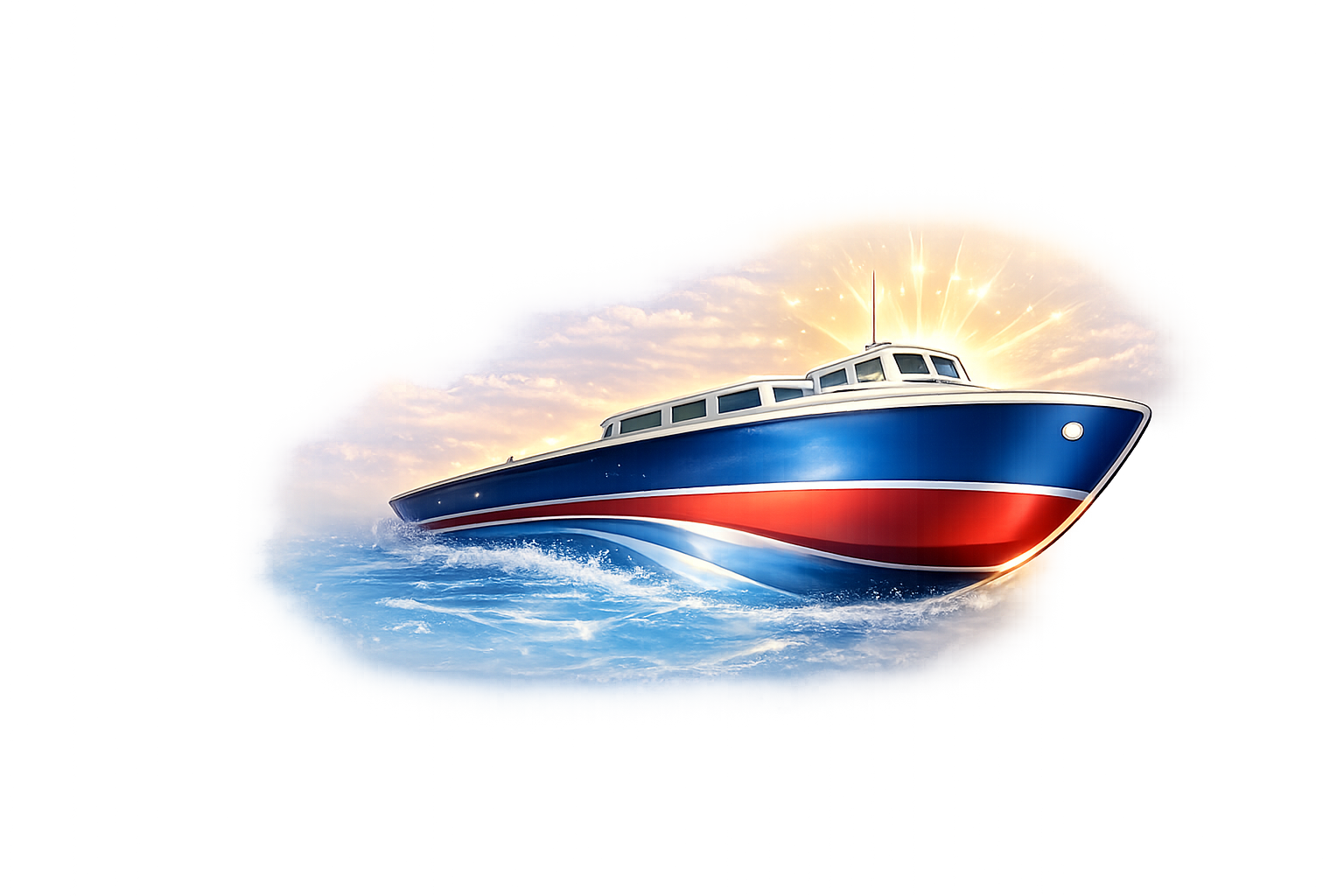
This is my scratch built 36" RNZAF British Power Boat 64' HSL (arrived in NZ 1940). I actually went on board this vessel in 1968 when it was still in original form (the RNZAF having disposed of it in the 50s) This vessel is still around and has been recently re modelled (2nd time since early 70s) and I was lucky last year to have met the present owner and go on board (2nd time in 49yrs!)and take a few photos. The vessel was modified a number of times by the RNZAF over the years (air intakes, removal of the fore deck machine guns, wheelhouse turret etc so I sort of went in the middle. I found a few drawings of the type in an old mag which had side and top views plus the bulkheads and their positions, so I took them along to a copying shop and kept enlarging them until I had the desired proportions. This worked out quite well and using a few methods from other models I had built, managed to frame (ply) the hull and then fully strip plank it in balsa. it was then fiber glassed. The deck is ply, lined and varnish stained. The wheelhouse is varnished balsa with the top removable for access. The wheelhouse interior has detail such as controls, instrument panels, skipper, steps to wardroom etc but is not too detailed as it is not seen. The boat has full lighting by remote switch, lights are all LED.
The propulsion side has dual everything (motors, ESCs, sound units), would have had 3x but ran out of space! Motors are 28mm 2200Kv water jacketed in-runners (cooled by remotely switched pump) using 30A Chinese ESCs (have 5A BEC, Fwd and Rev). Twin sound units are 'GT Power' car units which have around 40 different sound selections, from Cosworths to diesels and are computer programmable (as well as manually on the unit ) for various functions. I am using one of the v8 sounds (8 cyls short in my application) which I think is as near as you are going to get to 3 Napier Sea Lions (for which there is obviously no sound available) They 'start' 'Idle' and are fully proportional in fwd and rev and can sound quite realistic (will attempt to put up a vid later).
Batteries are 2x 2200mah 2s 20c LiPos which will last around 2hrs at least of sailing (they also run the sound units) Still have a few small things left to do (have just made wheelhouse air intakes) but don't want to get too fiddly. Just want to keep it a practical model.
Thanks for the kind comments. Planking did take a couple of days but was not done all that neatly (just clamp and cyno) as I was glassing it later - it was all thin resin coated inside to seal it). Planking was just a hint at the original so you could just make out the planks through the glass. Have included a few more pics of the motors and interior which is not that flash but is unseen, (more for the fact that I had seen the original and was sort of putting down what I remembered from when I was 15) There is a small picture at the top left of the stairs which on the original, was a Photo from an HSL looking off the Stbd rear 1/4, to 2 64ft HSLs side by side climbing over its wake at speed
The stair set is the original from the wheelhouse to wardroom, which has been kept and used again by the present owner (down to utility room in front of engine room) and still has the original 'POWER BOAT' rubber treads (not bad nick for 79yrs old!)
My dad built this over a long period of time, starting in the '80s. The hull is fibreglass and the rest is scratch built from plastic card, balsa, ply, wire and anything else he could adapt.
Although he installed the motors, props and rudders he never completed the RC installation or tested it. I inherited his boat models a few years ago and wanted to "finish the job", getting the model on the water. After installing the RC gear and batteries over the last few months, this weekend was the first sailing outside the bath at the Valley Gardens boating lake.
Happy to report that it sailed really nicely, seems to be reasonably stable although I did restrict it to calmer times when the MTBs and faster boats weren't running !
HMS Cadiz was a battle class destroyer, laid down and launched during WW2 although she didn't receive her commission until 1946 so didn't see combat with the Royal Navy, serving with the home fleet. Due to the changeover in pennant numbering she was originally allocated R09 and later, when the admiralty decided to revert to the D for Destroyer pennant numbering she was assigned D79. To reflect this my model has D79 on the starboard side and R09 on the port side.
She was sold to Pakistan in the late '50s, and renamed PNS Khaibar. She was sunk with the loss of nearly all hands in 1971 in the indo-Pakistan war.
On the pond today. Sailing well, though took on water easily over the combing into the cockpit. So back home I added a clear covering which should take care of that problem.
This pond yacht was bought for me by my daughter in a pretty poor condition from a car boot sale, I decided to tidy it up and give it back to her as a model for her home. 'True Balou' was her much loved 'Staffie'.
Landing craft (Tank) 548 a world war 2 Landing craft with Sherman tank and truck carrying British markings of the divisions landing at Normandy. Landing craft is running 2.4 ghz radio gear with 3 channels in use. I brought this second hand and am steadily improving it. Getting the ramp to work properly was the first struggle. See photo gallery for more information.
PT 109 was one of the hundreds of motor torpedo boats (PT) of the PT 103 class completed between 1942 and 1945 by Elco Naval Division of Electric Boat Company at Bayonne, New Jersey. The Elco boats were the largest in size of the three types of PT boats built for U.S. use during World War II. Wooden-hulled, 80 feet long with a 20-foot, 8-inch beam, the Elco PT boats had three 12-cylinder Packard gasoline engines generating a total of 4,500 horsepower for a designed speed of 41 knots. With accommodations for 3 officers and 14 men, the crew varied from 12 to 14. its full-load displacement was 56 tons. Early Elco boats had two 20mm guns, four .50-caliber machine guns, and two or four 21-inch torpedo tubes. Some of them carried depth charges or mine racks. Later boats mounted one 40mm gun and four torpedo launching racks. Many boats received ad-hoc refits at advanced bases, mounting such light guns as Army Air Forces 37mm aircraft guns and even Japanese 23mm guns. Some PTs later received rocket launchers.
This Proboat PT 109 model was brought in 2013 for £100 these boats are rare now, This one had a few faults with the propshafts they were bent and noisy both were replaced, with quality 4mm shafts, motors twin 600s were also replaced by Graupner versions along with mounts and couplings, basically all the running gear, also two ESCs by Aquapower were added and a 2.4G RC system.
Dumas kit Carol Moran, renamed Michael for my first grandson.My first build, learning how to make those brass railings each post being soldered following a paper pattern. Some customizing at the request of my grandson with added port holes, and deck features. He helped to paint it.
Looks great.... a ‘team’ effort. Well done. I’m just beginning my first build having just finished a workstation to house tools etc. All very satisfying.
Lots of nostalgia and really looks like a working tug.
Be good to see some on water pics. Your grandson must be very proud and is to be congratulated on the painting.

The stair set is the original from the wheelhouse to wardroom, which has been kept and used again by the present owner (down to utility room in front of engine room) and still has the original 'POWER BOAT' rubber treads (not bad nick for 79yrs old!)